Monday, April 16, 2012

VROOOOOOOOMMMMMMM!!!!!!!


I completed a two day motorcycle riding course offered by the Motorcyle Safety Foundation.  Here is the result.

It was a loooooong two days.  Actually, this is the work of a recently deceased Tucson artist who worked in metal and discarded items.  However, if I did ride anywhere other than the football sized range on which I practiced, I would most likely closely resemble the image above.

And yes, I did indeed pass both the written test and the range riding test -- evidence above.  If I lived in Arizona, I would have trotted down to the DMV this morning and exchanged this piece of paper for a motorcycle endorsement on my driver's license, making it legal for me to ride a motorcycle of any size, shape, and form not only in the state of Arizona but anywhere in the U. S. of A.  Given that I had the lowest passable score on the riding test of any person who'd ever taken it (I may be exaggerating but not by much), I agreed in writing, using my own blood, to never, ever take the handlebars of a motorcycle within the state of Arizona.

If I don't get a motorcycle, though, what am I going to do with this cute little sticker?  Suggestions accepted.

My class was intime, to say the least.  For most of the course, there were only three of us.  Here are two of my fellow students as we face our written test.  No wonder Jacki has such a dour look.  For me, of course, the written test was a breeze.  I'd typed out the practice questions in the back of our book, then typed in the answers, complete with page number where each answer was located.  I highlighted the answers in red, and printed three copies, one for each of us.  Can you spell a n a l?

One of our two instructors, who looks as if he's assuming the persona of evil testing person.

And the second instructor, out on the range.  Course format was about 8 - 10  hours of classwork, and about 8 - 10 hours of riding instruction.  Instructors are certified by and follow the curriculum of the Motorcycle Safety Foundation, although the course itself is offered through Pima Community College.  Fortunately for me, the West Campus where the range is located is about three miles down the road.  I say fortunately because we began at 6:30 AM.  Both instructors participated in both class work and range instruction.  And, again fortunately for all of us, we were a very small class.  I say fortunately because, as a student on the range, I self-classified into the severe developmental delay category.

All the stuff on the table and bench is mine.  I'm a wuss; I don't like discomfort, such as comes from cold, wind, and rain, all of which we had on Saturday morning, our first day on the range.  With me I had extra pants, shirt, and dry socks.  The dry sock thing is genetic.  Daddy said that after the invasion of Okinawa, when the Marines had to wade ashore from their LSTs, the first thing he did was pull out a pair of dry socks and put them on.  On this day in April but an almost wintery Saturday morning, I was wearing sweats under water-resistant pants with a warm lining, and four layers on top.  Except for my hands (I was wearing crummy left-over gloves from previous students), I was warm!

Sunday morning on the range was sunny and became warm, but at 6:30, it was still chilly, especially when riding, even though I'd barely make it up to 15 miles per hour (aka the fear of falling factor).  Here I am stripping down a bit, having removed the sweat pants, a few top layers, and am now putting my shoes back on.  Beautiful, beautiful day.


And a happy me.


The riding range is the size of a football field, and sits just down from PCC's instructional buildings.  We could run up to the buildings if need be, but why waste precious riding time?


When students arrive, motorcycles are ready.  Otherwise, they remain quiet in a beat-up cargo container, along with helmets and crummy gloves, if a student lacks them.  This makes it possible for someone like me, who lacks a helmet, to be able to ride.


#10.  Mine own for range instruction.

Sweet little machine.  Just my size.

Jackie and Larry await range test scores.  I didn't think I would pass the range test, as I'd gone so far outside the box that even Boss in Cool Hand Luke wouldn't have been able to find me.  The box is a rectangle within which the rider does two U-turns, entering one end and exiting the other.  I'd actually managed one very good box during practice but during the test couldn't do it with three tries.  Regardless of whether or not I passed, I was thrilled that I'd actually finished (and with minimal whining), especially given the miserable weather on Saturday.  My fellow classmates had least some riding experience, and had done well on the range, and I knew they'd pass.  The instructors had assumed I'd want to be the last person to test, and were a bit surprised that I wanted to go first. 

Notice how beautiful the weather is:  sunny, clear, no clouds.  Contrast that with the day before:  miserable, wet, rainy, cold.

Instructor expressing his feelings about having his photo taken.

Class photo!!  The young man on whom I have a strangle-hold joined us only for Sunday's range instruction and testing.  His class had actually been cancelled about halfway through because the weather got so bad.  Apparently, that's a rarity.  He was reluctant to join in the photo but he had no choice!  My fellow students were very kind to me, in my ineptitude.  Thank you to them and to our intrepid instructors!

Wednesday, April 11, 2012

How to Dry Clothes in Dry Climes

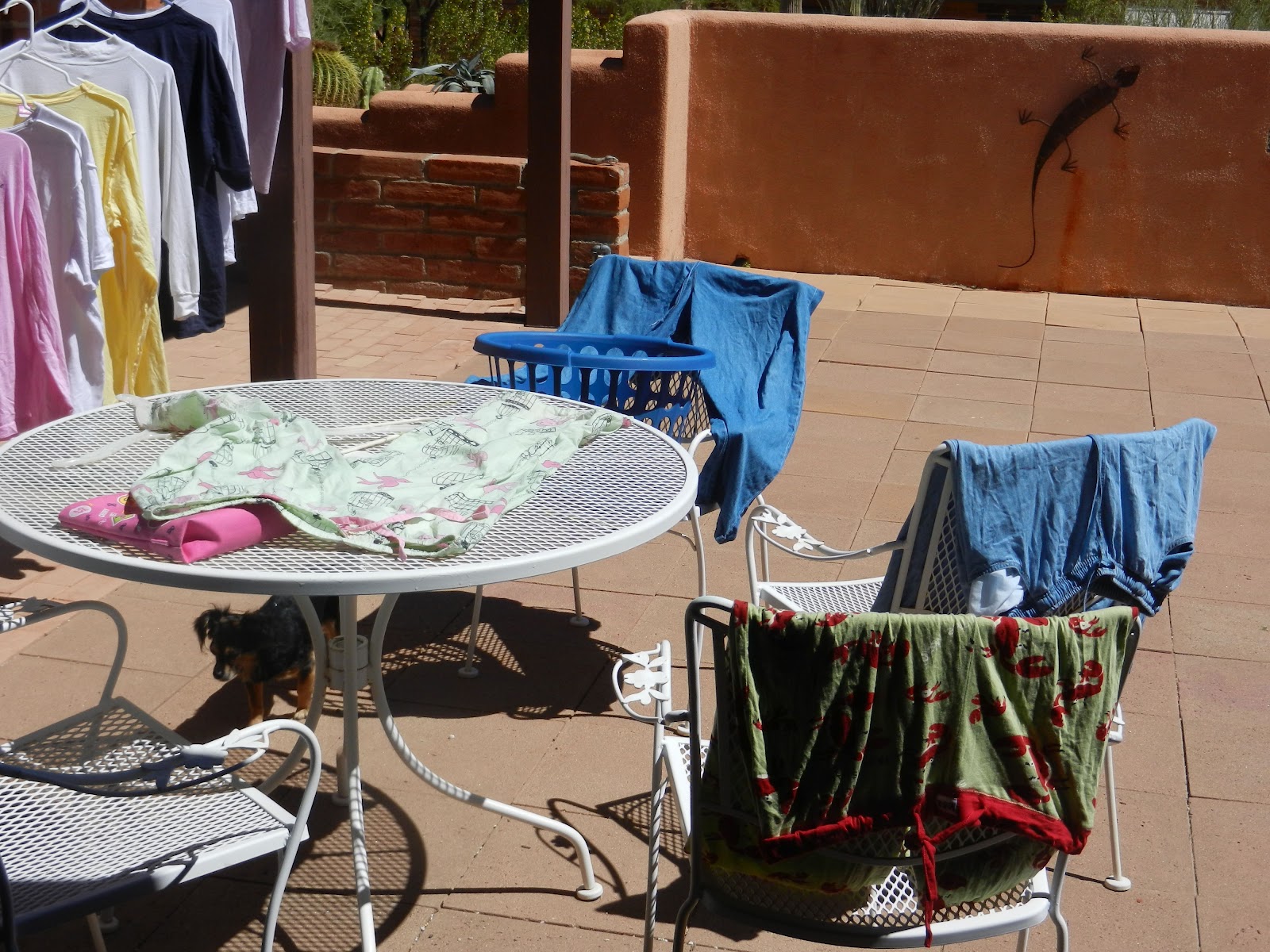
OR: No This Is NOT a Yard Sale.  Way back when we bought a house in Tempe, we very quickly bought a washing machine; I HATE going to the laundromat.  However, we held off getting a dryer, instead stringing line around the carport.  Clothes were protected from the sun and in the "dry heat" of Arizona, well, they were dry almost as quickly as I got them hung out.  When it rained, we'd hold off washing, unless it was a necessity; then, we'd run down the street to friends and use their dryer.  That worked pretty well, since it didn't happen more than about once a year.  Then we hit a rainy spell.  And it rained and rained.  We built an ark, and it rained some more.  We bought a dryer.  Back in Tucson, I'm loathe to use the dryer when the sun is free...and fresh, so here's my method.


Oh yeah.  Gambel's quail.  The reason to watch carefully.


Hail!

Hail happens, even in Tucson, though rarely.  And here's the evidence.

I like hot-tubbing when the air is cold, but not sure about being hit by hail, even though the hail was a bit smaller than a marble.  Even my head isn't quite that hard...I think.

Didn't hide the patio stones but covered them pretty well.

Not only did this volunteer survive, it is thriving.  I've been pulling other little green stuff that sprouts between the patio stones but this one had the courage to bloom around the time I arrived...and will be there when I leave ... which will be soon.
 

Ouchy!

The desert is not the place to walk barefoot.  The desert, in fact, requires, nay demands, strong footwear.  Neither Shirley's backyard nor front yard nor side yard has that green stuff on the ground that back east we call lawnShirley's yard is desert.  So walking Abbey in the back desert with me wearing flipflops was....


Not intelligent, as you can see from a couple of the critters which I removed from one foot.  I call them critters rather than plants because, without any provocation whatsoever, three of them leaped off the ground and viciously attached themselves to my foot.  They are impossible to remove by hand.  And they seem to have little barbs which imbed themselves into tender, innocent flesh.  I had to remove my flipflop and limp, with the maimed foot bare, over rocky ground, back to the house.  Now, an efficient and effective way to remove these barbarians from flesh is with a comb, but I'd forgotten that technique.  Altogether, I had 11 barbarian invasions from the three pods.  Several were in so deeply that their departure left little puncture wounds.  Fortunately, no infection.    Damn dog!!!

Friday, March 23, 2012

Goodbye Texas

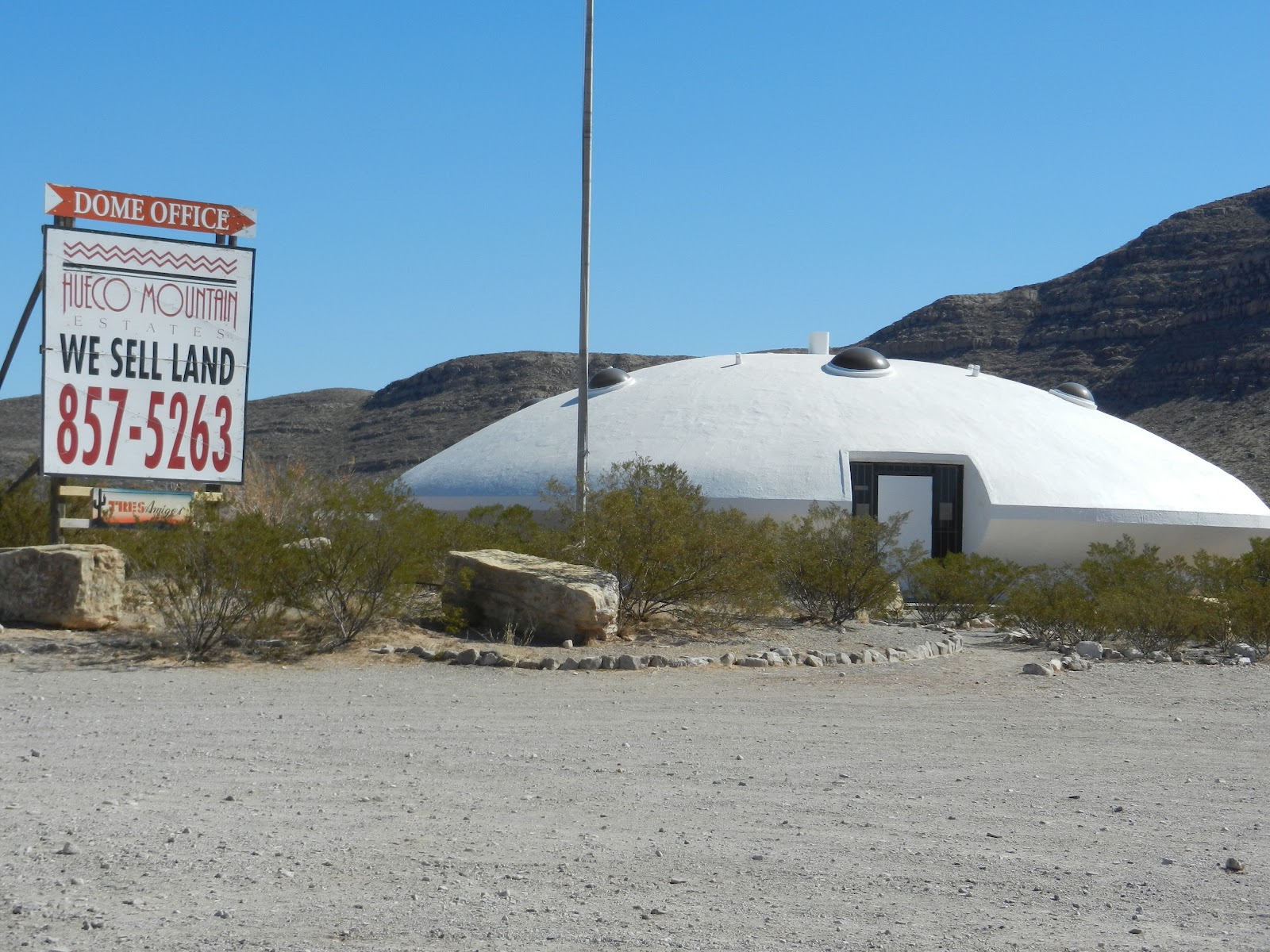
I'd wanted to go to Roswell, NM, to savor the proximity to aliens and UFOs and just general weirdness, but it was too far off my uncharted path,  Fortunately, I had a small taste of little gray men on the outskirts of Hueco Tanks.


Not a new home to be seen.

Friday, March 16, 2012

Hueco Tanks...A Disappointment

On the recommendation of the wonderful NPS staff at Guadalupe Mountain and in hopes of seeing petroglyphs, I took a side trip to Hueco Tanks, just outside El Paso.  El Paso is about a gazillion miles long, with I-10 running down the middle, and ten miles wide, except in one area which is where I turned off for Hueco Tanks and that piece of El Paso was another half a gazillion miles.  El Paso is not pretty, folks.  And the signs for Hueco Tanks State Park and Historic Site...or the lack thereof...merit attention by the State of Texas, if and when it can get its feeble little mind off  sex.

A word about state parks out west:  Because the federal government first saw the value in the areas which became our magnificent national parks, such as Grand Canyon and Yellowstone, western states, which had gained statehood later than their eastern sisters, didn't have much to choose from for state parks.  Yet many western state parks are little gems.  Hueco Tanks could be a little gem but.....

Originally, this area had been privately owned, then county owned, before it was passed on to Texas Parks and Wildlife.  In his first incarnation, it had both historic and prehistoric significance.  Prehistorically, the area attracted Native Americans, later including Mescalero Apache who drew pictographs and petroglyphs.  The tanks, or rock basins, captured always-needed water.

Later, ranching arrived, as did the Butterfield Stage.

Today, this little 800 acre park draws about 100,000 visitors from all over the world:  not for the prehistory, the history, the wildlife or vegetation, but for the rocks.  Apparently, Hueco Tanks is one of the best in the world bouldering.

It gets so crowded that the number of vehicles through the gate must, at times, be limited.  When I arrived, it was swamped with climbers:  young, healthy, cheerful -- and interested only in bouldering.

Texas parks are starved for money, and Hueco Tanks is no exception.  The entrance is not designed to handle the traffic, and the building into which we all disgorge was built for a calmer, less visited time--about 40 years ago.

The staff was very, very nice, though clearly overworked with all the young climbers trying to get permits and directions.  Cheerful voices rang out as climbers greeted one another.  Vehicles piled up outside.

Paying my entry fee, I edged my way to my car, where a pleasant ranger reminded me that under Texas law, dogs could at no time, even in the cool temperature that day, be left in the car.  Nor could they be taken on any of the trails.  That meant no petroglyphs. I was disappointed, but understood.  Texas was more concerned about the health of  dogs than about the health of Texan women. 

I headed to the interpretive center, which is in the old ranch house.  I'd been told the canines would be allowed in, and they were.  However, I left them in the car long enough to dash up to the small center and ask about the bathroom.  Very rudely, an old man who'd forgotten to shave for a few days, snarled, "We don't have one.  Use the one at the entrance."  I knew he was lying.  I turned around, and darned if the door didn't slam behind me as I walked back to the car.  I did not return to the entrance but will say no more.  When I returned with the dogs, a woman volunteer apologized and said the one they had was out of order, but she was new and hadn't known.  The nasty old coot had left by then.

The volunteer was very nice.  Her primary job was to enforce the requirement that everyone who came into the park view  a video about the park.  All parks have a video; most are well done and informative.  This video was also well-done and informative ....  with a strong threatening undertone.  

The usage of Hueco Tanks as a climbing site is overwhelming the human, historic, and natural resources.  It isn't that the climbers are bad folks; they're exuberant and excited.  And they're there to climb, with the other resources as an aside.  The video wanted all visitors to enjoy the park, but to remember that it's a fragile place.  Once I'd viewed the video, my name was entered into the Book of Doom, and I was given a ticket that granted reprieve from viewing the video again for one year.

My guess is that snarly old coot, another volunteer,  had assumed I was a climber; I was rather scruffy looking, if a bit old to be crawling over the rocks unroped.  And he was just sick and tired of climbers ignoring the history and prehistory of his beloved area, and assuming they could go anywhere....  It's either that or he was just a snarly old coot.

I do have some photos....


Waco Tanks:  Hueco, pronounced Waco, means hollows.  Tanks, huecos, are natural rock basins that catch and hold water.

I am always intrigued by these historic ranch houses, which at one time were in the back of beyond.  My mother grew up in a farm house without running water or electricity, but she could walk to school and had friends on nearby farms.  These western farms and ranches were often fairly isolated.  It's hard for me to imagine what daily life was like.

Back in ranching days, the grass would not have been allowed to grow so tall, so close to the house.  Given the fire danger today, I'm surprised that it was so high when I was there.  What I like about the house is that it blends into the environment; it looks as if it belongs.  The rocks in the background are similar to those that attract boulderers.

The romance of the overland mail and passenger stage.  In this instance, it's a fraud, which I did not find out until after I'd taken these photos.  The stage/mail stop was not here; the stones were moved from another location but there is no indication of that on the sign.  This lack of historical honesty reflects Texas in general.  Try visiting the Alamo.


Another example of underfunding:  slopping cement on top of the wall to keep the wall from eroding.  Professional preservationists weep at the sight. 

Now, however, we have two very happy mammals.  Almost no park, federal or state, could function without volunteers, who serve as campground hosts and interpreters, among other necessary tasks.  This woman lives in her RV, going from park to park, spending two or three months at each park.  Living with her are three canines. Tobey can tell......

And so we left Hueco Tanks....and Texas...on a happy note.

Thursday, March 15, 2012

Don't Tell My Mother that I'm a Motorcyle Mamma!

When I lived in Tucson about a million years ago, I earned many passenger miles on a Honda 305, nicknamed Moby, since it was white and weighed a ton.  I toted up about 1/4 mile as moto operator, the first time found me and Moby in a ditch on Mt. Lemmon.  The second time I had the courage to rev it up to second gear as I toddled around the block in sheer terror.  Neither was what I might term a major success. 

Now that I'm out here in my later years, I decided to go about this learning-to-ride-a-motorcycle in a more systematic way, as befitting a retired college professor:  I signed up for a short course offered at Pima Community College and taught by an instructor certified by the Motorcycle Safety Foundation.


My charger awaits me!

Our intrepid instructor, who's logged over 100,000 miles on two wheels with a big engine in between.
Goo
One of my fellow students, who looks about the age I was when I was out here a million years ago.
She, her friend, and I were the only students, a student/teacher ratio which I definitely appreciated.  And, they appeared with proper gear, including helmets, gloves, and leather jackets.  Their husbands both own motorcycles.


 And then there's moi:  borrowed helmet, borrowed gloves, no leathers...though it was much too warm for leathers.  I soon discarded my vest.  Our instructor was adamant that before we even mounted the motorcycle that we be wearing our gear:  long sleeves, gloves, helmet, and eye protection, either a visor or glasses.  Since we were not leaving the safe (relatively) confines of the ring, sun glasses were OK.


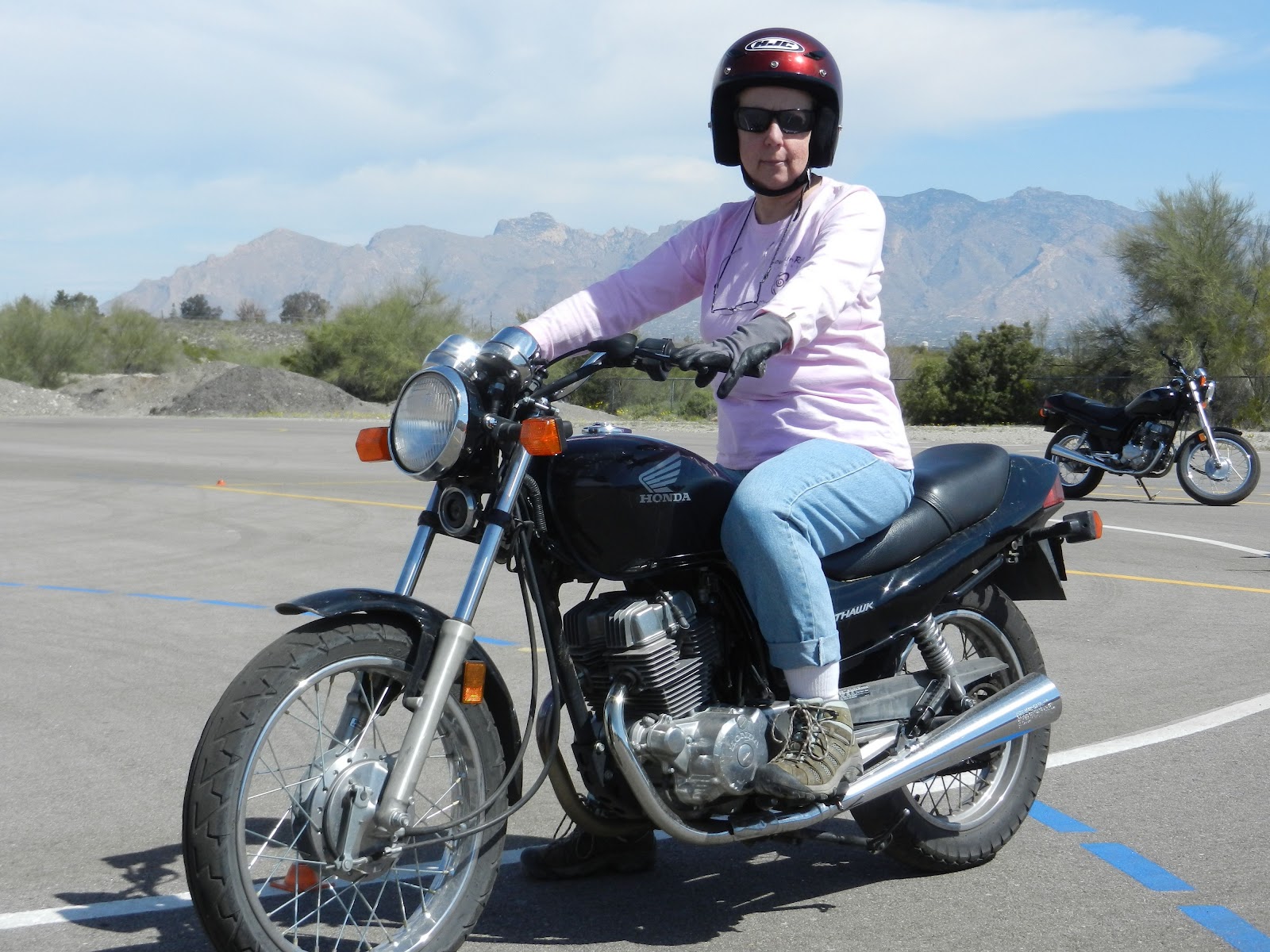
Proper gear on.  Bike locked.  Stand down.  Mount up.

Good form in the mount up.  Wheel turned properly.


Note Mountain Rose shirt. What the well-dressed motorcyclist is wearing today.
A confession:  We never went higher than first gear, riding in circles around the training ring.  For those few motorcycle novices out there, most motos have gears....and a clutch....and two brakes.  While the concept of clutching, gearing, and braking is similar to that of a manual transmission automotobile, the clutch is at the left hand, one brake at the right, and the accelerator is on the right handlebar.  The gearshift is at the left toe.  What we do in a car with our feet, we do on a moto with our hands.  I had to practice a new system, to habituate my brain to a different way of doing things.  It was great fun, but also tiring, so riding in circles in first gear, practicing shifting to first, going a short way, slowing down, and braking was actually sufficient unto the day.

Attesting to successful completion of my "Motorcycle Experience."

And now I'm ready for.....NOT!